Showing posts with label northern territory. Show all posts

Wednesday, September 13, 2006

We do have friends (The Sequel)

The tourist
Doug, Jackie, Nico, and Uluru...one big happy family
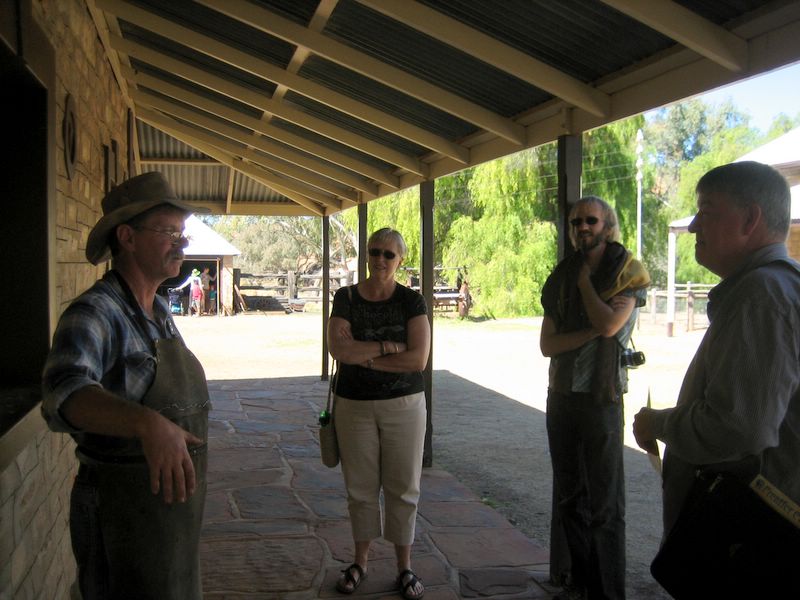
A big thanks to Jackie and Doug Cameron (Nico's parents) who DID indeed make the 24 hour pilgrimage by plane from Canada all the way down under. For the first part of the trip I was back in Canada for work but managed to hook back in time for a visit to Alice Springs & Uluru, which Nico has already posted about. It was super nice of them to fly us out to visit the rock with them. It was also great to see them here!! Which one's the real Uluru?? At the ORIGINAL Alice Springs with Blacksmith tour guide - home of the central telegraph relay station

Highlights were visiting Uluru and Kata Tjuta (procouned Karta Choota) as Nico pointed out earlier.

While in Alice Springs (about 500 kms from the rock) we also hit the site of the REAL Alice Springs where the central telegraph station was built back in the 1800's. It cost 328,000 pounds to build and stretched from Adelaide to Darwin through the driest desert. The 'little town down the road' called Stuart (or Sturt...can't remember) eventually outgrew Alice Springs which went through many transformations from telegraph station, to POW camp, to Aboriginal indoctrination center (when the government took kids away from their parents in the hopes to indoctrinate them into white society,) etc. Now it's a historic park. Sturt took the name Alice Springs sometime in the 1900's.

Friday, September 08, 2006

Ants on the Rock

This is why you avoid Uluru mid-morning.


Busloads of Tourists Climbing Uluru

Monday, September 04, 2006

To vote Damo off, dial . . . .

Kata Tjuta (the Olgas)

fact: Kata Tjuta (the Olgas) was even more stunning than Uluru. But that begs the question: is Damo even more stunning than Kata Tjuta? We hiked between the weirdly shaped bulges as Damo posed and preened.

Work it, Damo, work it!  Photo shoot at Kata Tjuta (the Olgas)A tiny Damo against a giant rock wall, Kata Tjuta (the Olgas)

Sunday, September 03, 2006

One Giant Rock

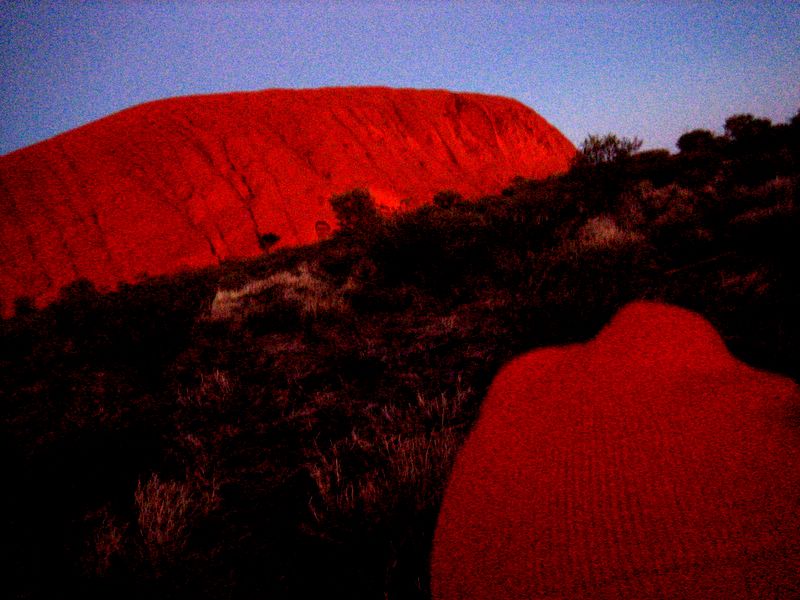
Uluru at sunset

fact: Uluru (Ayer's Rock) is indeed a great big rock. I know that may seem pretty self evident given its previous name but it wasn't until we got there that the immensity of this giant pebble hit home. It's not a big hill or a small mountain--it's one big red rock. Like an iceberg, a good chunk of it is underground. 345 metres are above ground and that's what we climbed.

Look down, way down.  The view from Uluru
fact: it is strongly recommended that you don't climb Uluru. Climbing was part of an initiation ceremony that marked the passage of boys into manhood so there's a cultural reason why they ask you not to climb. Secondly, it's just dangerous. At times, you're on a razor edge ridge, with just a metre of sloping space before the edge steeply drops off. There is a safety chain, but despite that, I got a bit freaked. I'm not scared of heights but I just don't like precarious situations and this was one of them. Damo, ironically, wasn't scared at all and he has a height phobia. But the Rock was there and, like countless other tourists before us, we couldn't resist its challenge.


The pathway up Uluru
Triumphant Nik on top of the rockExhausted Damo resting on Uluru with the Olgas behind him

Thursday, August 03, 2006

Ubirr

Climbing the rocks at Ubirr, Kakadu National Park But, now you know this story,
and you'll be coming to earth.
You'll be part of earth when you die.
You responsible now.
You got to go with us.
To earth.
Might be you can hang on.
Hang onto this story.
To this earth.
Bill Neidjie, Gagudju Man (Aborigine caretaker of Kakadu)

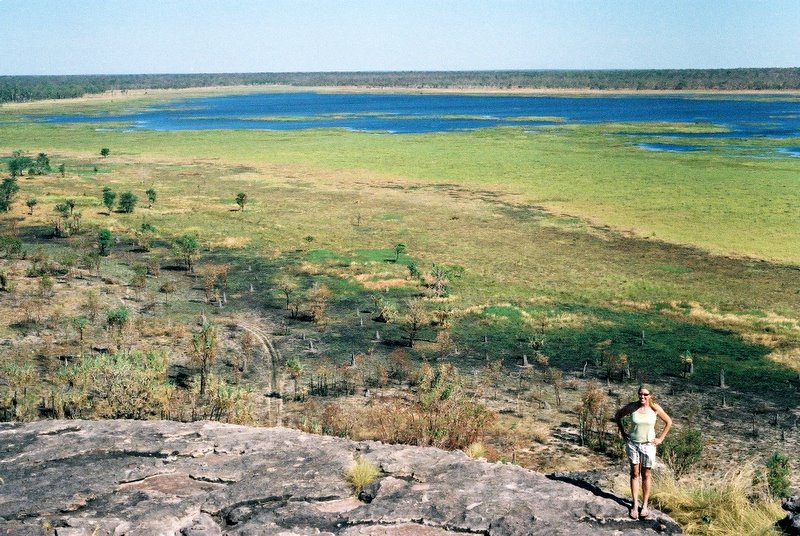
View of Kakadu from atop Ubirr


Breathtaking views of Kakadu from atop the rock.


Rock art depicting a war and a fishing trap, Ubirr, Kakadu National Park
Rock art found at Ubirr: a scene depiciting a fight between two groups, superimposed by a fishing trap.


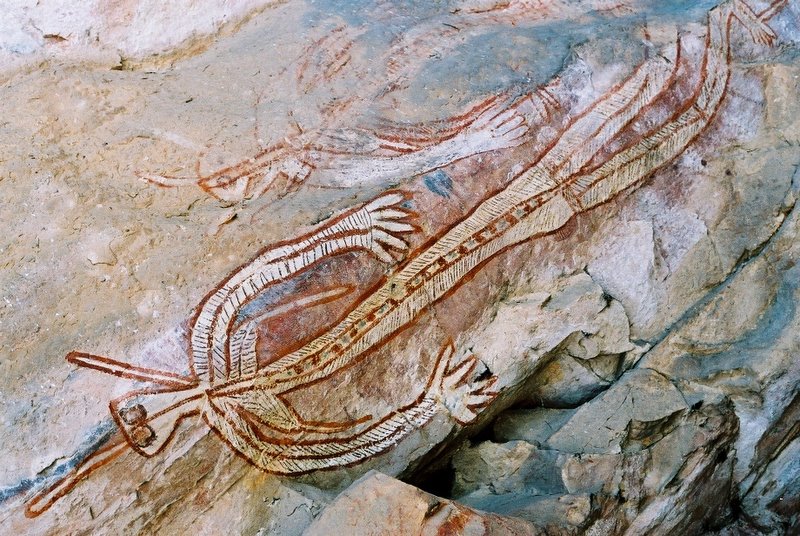
Mimi Spirit Painting, Ubirr, Kakadu National ParkLook up, way up, on the ceiling of this rock overhang, to see the cute little Mimi spirit. As it was generally accepted that no human hands could reach over and below the overhang from the clifftop, nor could they reach that high from the ground to paint this little critter, it is said to be the work of the Mimi spirits--a little "hello there!" to the the humans.

Saturday, July 29, 2006

rock art

Nourlangie Rock: Kakadu - Ms NipplyDay Four of our camping tour: After an early morning primer at the Warradjan Aboriginal Cultural Centre on the cultures of the different groups who lived (and still live) in the Kakadu area, we hiked out to Nourlangie Rock to see the rock art, such as Ms. Nipply pictured here (a bad spirit).


This overhanging rock was used as a shelter during the Wet and has layers and layers of paintings--some possibly as old as 65 000 years. There are many many more rock art sites all around Kakadu and across Australia, some Nourlangie Rock: Kakadu - overhanging rock shelter during the Wetpossibly 65 000 years old. Down south where we live, the recent bush fires in the Grampians National Park uncovered sites that no one knew about. There are also other sites that have restricted access due to the sacredness of the teachings and images.

At this site, there was a diversity of age and style in the paintings. Some were really old and more simplistic, such as these handprints. Others might be just a recent 200 years old--this ship records contact with the Europeans and, in other spots, lace gloves (like those worned by European women) and men with guns are painted on the rock walls. Nourlangie Rock : Kakadu - 20,000 to 60,000 year old hand impressions

It was amazing to see these messages from the past, the record of lives lived. Some of the stories and meaning behind the paintings have been lost when the different cultural groups have died out or been assimilated (forcibly and not). Other stories were not to be told outside a culture or gender group but there's been a recent push to break away from that tradition in order to preserve what knowledge still remains.

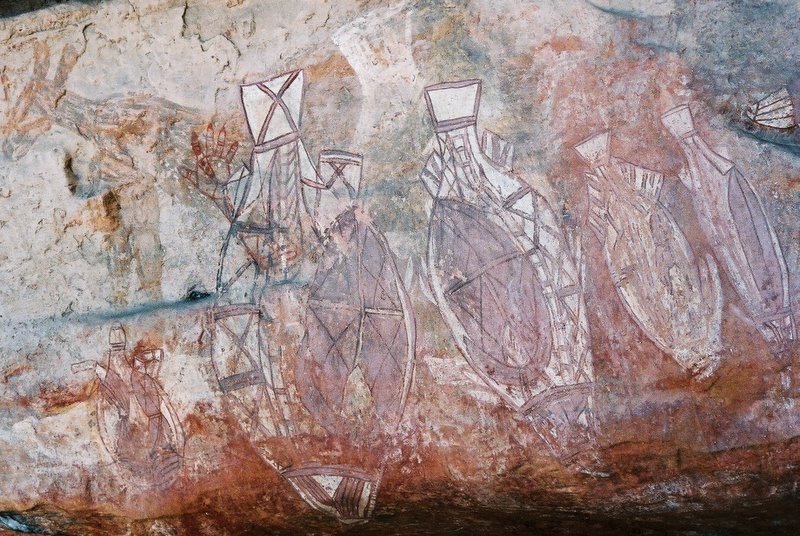
Here is the X-ray style of art--thought to teach the kids what fish or other animals were good to Nourlangie Rock: Kakadu - XRay Art 2,000 to 20,000 years oldeat and which parts to cut and use. Also probably a bit of magic involved in these paintings--good luck for hunting or reverence for the creature who provides subsistence. Look closely behind the fish to see the kangaroo, an older style painting over which the XRay fish and turtle were painted.


They estimate the date of the paintings using various techiniques - some scientific - and some less so. For example, the subject of the paintings can be used to date the image - paiNourlangie Rock: Kakadu - Contact Art European Ship, less than 300 years oldntings of megafauna that have been extinct for 20,000 years must be at least 20,000 years old. Those showing a boomerang used in hunting would coincide with the time that the area was open dry plains instead of heavily forrested (try using a boomerang in a heavily forrested area - it doesn't work.) Those of boats, called 'Contact Art', less than 300 years old.

The paintings also have three distinct styles. The earliest form (like the handprints) are simply impressions and date back to possibly 60,000 years ago. These images were made by holding an object against the rock, filling the mouth with ochre paint and spraying it onto the rock wall. The next phase were stylistic images - like a solid kangaroo, other animals, or a series of images that tell a story. The final and most recent style is XRay art which is at most 2000 years old.

Friday, July 28, 2006

crocs at jim jim falls

Wetlands in Kakadu National Park Birds over Kakadu wetlands (Crocodile snacks)
Look at this beautiful marsh area. Perfect spot for a croc, if you ask me, but that's where we ate lunch. We were on high croc alert that day. Note the signs at the start of each hiking trail that warn you of imminent danger.

We took a true 4WD out to Jim Jim Falls, none of that sissy pavement for us. Just red mud, sand and water on twisting track cutting through the trees. The falls had just recently been opened for the public but we could only go as far as the viewing area due to the danger of salties (or estuary crocs). So we had to content ourselves with a view from afar of these famous falls.Nico and Damo happily in front of Jim Jim Falls
Crocodile Warning Signs posted throughout Kakadu National Park

4WD on track to Jim Jim Falls, Kakadu National Park
(Day Four of our Camping Tour: PM)

Sunday, July 23, 2006

pool with a view

Day three of our camping trip: One waterfall after another . . . .

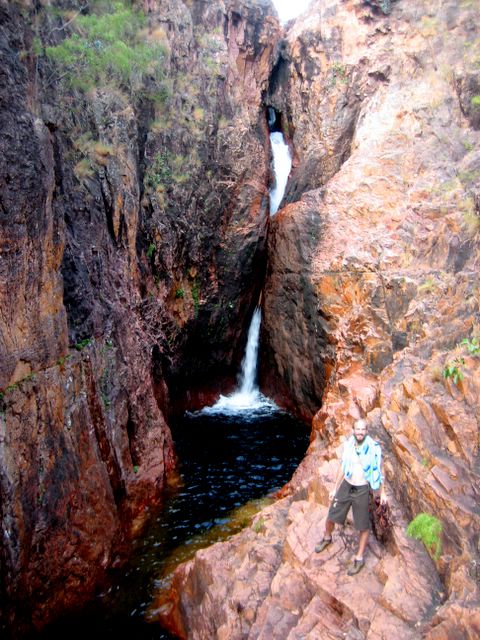
As Marco, a fellow campmate said, it was like God just realized, oh, oops, he had a whole bunch of beautiful waterfalls left over during creation so he just put them all in the Top End. Scott took us hiking up and down the rocky ridges of Kakadu on this hot day, each time to a waterhole even more lovely than the one before it. The highlight of each hike was, of course, a plunge into the cool water.
Above, the view from the bottom of the popular Gunlom Falls.


The stunning view from the top of Gunlom Falls.

A steep 15 minute hike up brought us to these pretty pools at the top of the falls with their awesome view.

Saturday, July 15, 2006

sheer cliff walls on either side


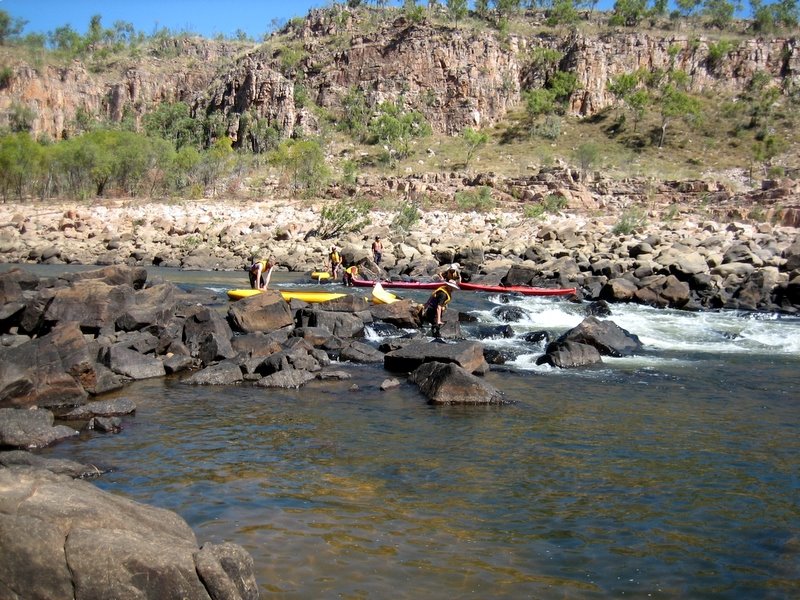
Day Two of our camping trip: Canoeing through the first two of nine gorges in the stunning Katherine Gorge Park. Loved the view; hated our 'canoe' and its paddles. I guess it was a sort of kayak but both of us would have prefered a Canadian style canoe--we had trouble keeping the boat straight! (And yes, it was the boat, not us.)

Look at how sun smart we are with our broad brimmed hats and me with my long sleeves. We saw some sort of water-happy snake and a little freshwater crocodile--quite shy and not at all dangerous, unless you provoke it by getting too close. Another moment of excitement was provided by our guide Scott and fellow campmate Toshi when they tipped into the water, not once, but twice. Ended the day with a spectacular sunset as we entered Kakadu to set up camp.


Us swimming with the crocs and Damo navigating the canoe around the rocks and through the white water between the two gorges.

Thursday, July 13, 2006

driving driving driving


our transportation, guide Scott and companions for the five day Wilderness 4WD trip in the Top End

one beautiful waterhole after another


After successfully completing the didje playing and spear throwing challenges, our group was deemed road worthy so our guide Scott loaded us up in the back of the 4WD and off we went. Our first stop was Litchfield Park, about an hour out of Darwin, to see the massive cathedral termite mounds and the cool flatten magnetic termite mounds with their north/south axis.

Although we couldn't find the clue box amongst the termite mounds, Scott still allowed us to carry on to the next leg of the journey, a chance to cool down in the Buley waterholes. It was crowded but the day was already hot so we didn't mind. Besides, the setting was spectacular, as Buley is a gorgeous series of about seven little rock pools with cascades between each.

Refreshed, we hiked to Upper Tolmer Gorge, clambering up, over and down rocks to reach our destination (as competently demonstrated by Kiki, a fellow camper). With a guide, we were allowed to access a restricted area to swim in yet another beautiful waterhole in between the little upper falls and the significantly taller lower falls.

Mid afternoon, Scott loaded us up one more time to drive for about two hours to an old deserted World War Two airstrip near Katherine to camp for the night. We roughed it out in the middle of the wilderness, using the bush as our toilet and sleeping in swags. A swag is an Aussie bedroll--a thin mattress in a canvas (oilskin?) bag to protect you from snakes, spiders, centipedes and mozzies. The night sky was clear so we fell asleep under the stars of the Southern Cross--it was beautful.

Friday, July 07, 2006

The Top End Is...

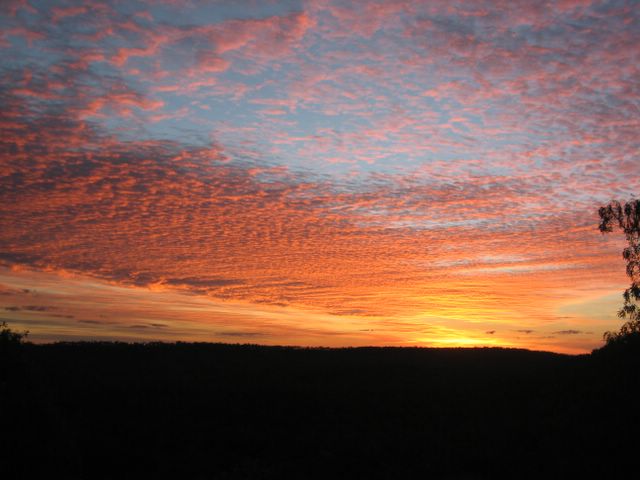
Sunset in Kakadu National Park Northern Territory The Top End Is
Sunset
Sunset at Mindil Beach Darwin Northern Territory
Waterfall in Kakadu National Park Australia
The Top End is
Water Falling
Waterfall in Kakadu National Park Australia

The Top End Is
Crocodile

5 Meter Estuary Crocodile Mary River Northern Territory Australia