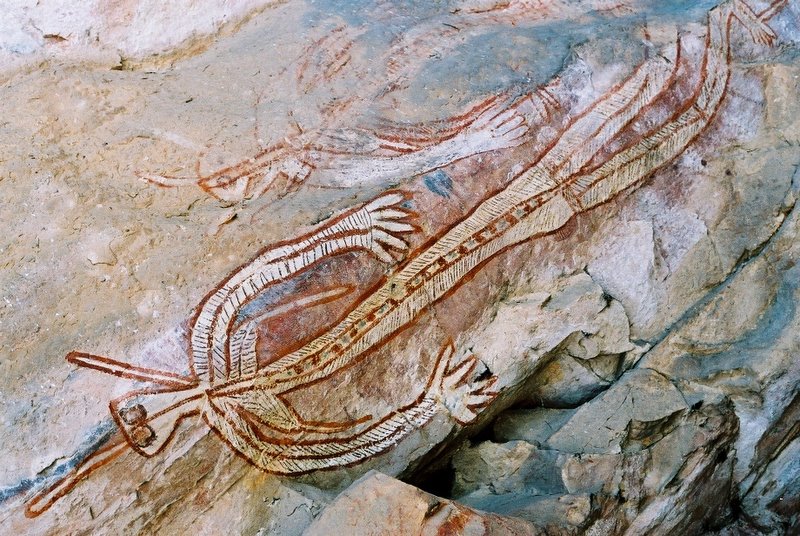
Day Four of our camping tour: After an early morning primer at the Warradjan Aboriginal Cultural Centre on the cultures of the different groups who lived (and still live) in the Kakadu area, we hiked out to Nourlangie Rock to see the rock art, such as Ms. Nipply pictured here (a bad spirit).
This overhanging rock was used as a shelter during the Wet and has layers and layers of paintings--some possibly as old as 65 000 years. There are many many more rock art sites all around Kakadu and across Australia, some

possibly 65 000 years old. Down south where we live, the recent bush fires in the Grampians National Park uncovered sites that no one knew about. There are also other sites that have restricted access due to the sacredness of the teachings and images.
At this site, there was a diversity of age and style in the paintings. Some were really old and more simplistic, such as these handprints. Others might be just a recent 200 years old--this ship records contact with the Europeans and, in other spots, lace gloves (like those worned by European women) and men with guns are painted on the rock walls.

It was amazing to see these messages from the past, the record of lives lived. Some of the stories and meaning behind the paintings have been lost when the different cultural groups have died out or been assimilated (forcibly and not). Other stories were not to be told outside a culture or gender group but there's been a recent push to break away from that tradition in order to preserve what knowledge still remains.
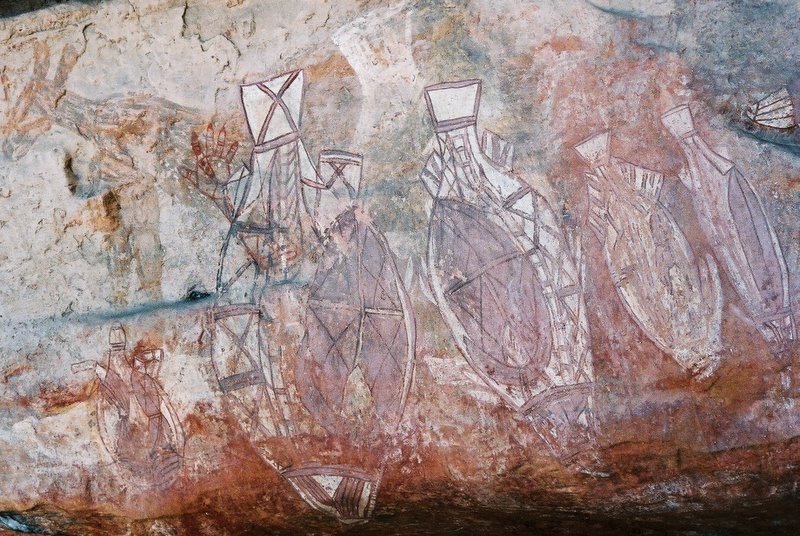
Here is the X-ray style of art--thought to teach the kids what fish or other animals were good to

eat and which parts to cut and use. Also probably a bit of magic involved in these paintings--good luck for hunting or reverence for the creature who provides subsistence. Look closely behind the fish to see the kangaroo, an older style painting over which the XRay fish and turtle were painted.
They estimate the date of the paintings using various techiniques - some scientific - and some less so. For example, the subject of the paintings can be used to date the image - pai

ntings of megafauna that have been extinct for 20,000 years must be at least 20,000 years old. Those showing a boomerang used in hunting would coincide with the time that the area was open dry plains instead of heavily forrested (try using a boomerang in a heavily forrested area - it doesn't work.) Those of boats, called 'Contact Art', less than 300 years old.
The paintings also have three distinct styles. The earliest form (like the handprints) are simply impressions and date back to possibly 60,000 years ago. These images were made by holding an object against the rock, filling the mouth with ochre paint and spraying it onto the rock wall. The next phase were stylistic images - like a solid kangaroo, other animals, or a series of images that tell a story. The final and most recent style is XRay art which is at most 2000 years old.
 But, now you know this story,

 Look up, way up, on the ceiling of this rock overhang, to see the cute little Mimi spirit. As it was generally accepted that no human hands could reach over and below the overhang from the clifftop, nor could they reach that high from the ground to paint this little critter, it is said to be the work of the Mimi spirits--a little "hello there!" to the the humans.







 capture the colours.